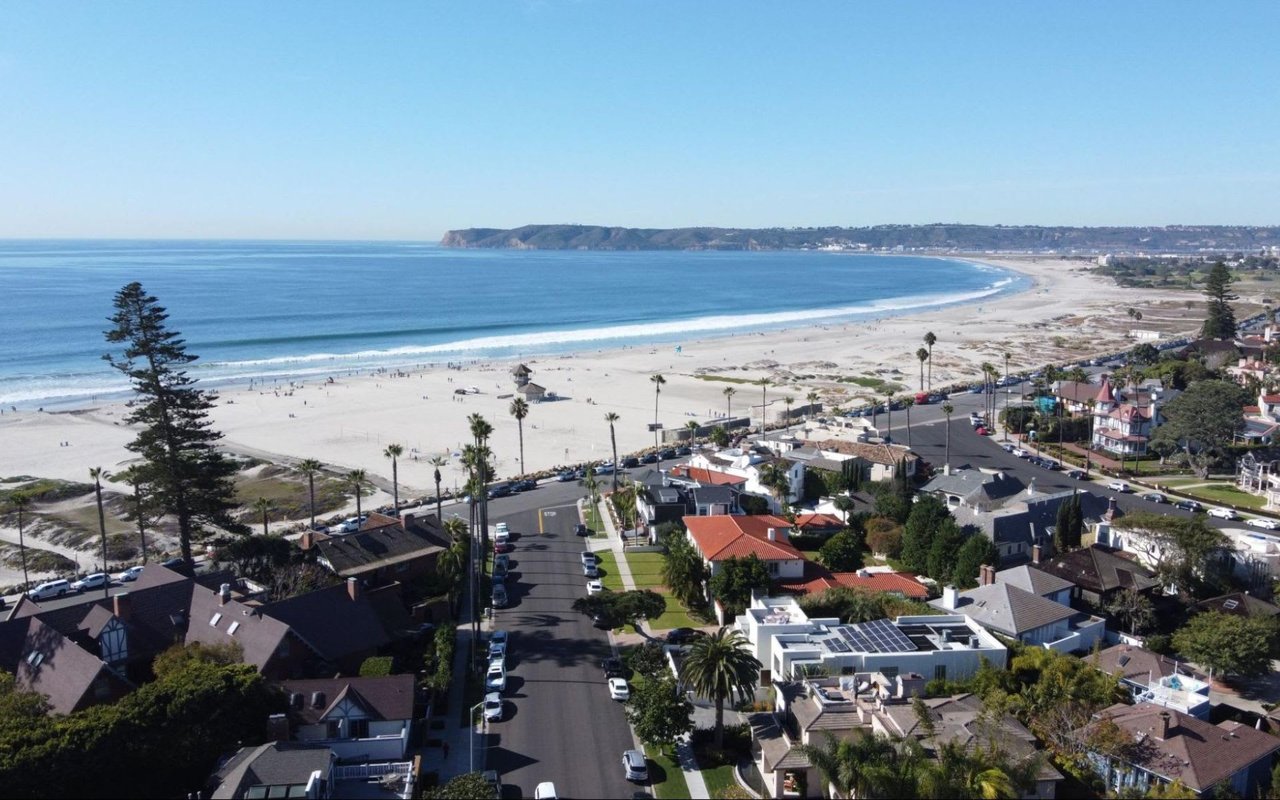
On July 28, city officials gathered at Coronado Cays Park for a ribbon-cutting, the kind of small civic ceremony that usually draws a handful of people and a press release. This one drew dog owners. Some brought puppies. One woman brought her six-month-old, newly comfortable off-leash for the first time in a space that wasn't hemmed in by a busy street on one side and a soccer field on the other.
The occasion was a fence. Just under 1,100 linear feet of it, four feet high, wrapping the off-leash dog run at Cays Park that had operated, unfenced, for years. It sounds like a minor parks project. It is actually the resolution of a fight Coronado has been having, on and off, since at least 2018, over whether the island would have any fenced off-leash space at all. And it does not resolve the second, quieter argument still sitting underneath it: how big that space gets to stay.
The Fence Coronado Almost Didn't Get
Coronado has tried this before. In 2018, the city and the Coronado Unified School District negotiated a proposal to convert part of a three-quarter-acre grassy lot on Sixth Street, next to the district office and a childcare facility, into a fenced dog park. The city offered the district $60,000 a year for the arrangement. A double fence would have separated the children's space from the dogs'.
It never happened. Residents split hard over the idea of putting an off-leash zone next to a preschool, and after an hour of public debate the council pulled back rather than force it through. No timeline was set for revisiting it. The project quietly died.
That history matters here, because the 2026 fence took a different path to the same goal: instead of carving out new ground near a childcare center, the city fenced a run that already existed, informally, at a park where dogs had been running off-leash for years without a barrier. Less new territory to defend meant less to fight about.
The short version of how Coronado got from a rejected proposal in 2018 to a ribbon-cutting in 2026 looks like this:
- 2018: A fenced dog park proposed on school district land near a childcare facility draws sharp opposition. The council shelves it indefinitely.
- July 2025: As reported by Coronado Times, the Coronado City Council voted unanimously to fence the existing, unfenced dog run at Cays Park instead, citing safety incidents involving unleashed dogs.
- Summer 2026: Fencing goes in over several weeks. The project is completed and celebrated with a ribbon-cutting on July 28.
Eight years is a long time for a fence.
What Actually Went Into the Ground
The scope, according to the city's own project documentation, called for approximately 1,100 linear feet of four-foot fencing, five single-swing gates, and two double-swing gates, tied into a new mowing strip along the perimeter. That total footage runs well past the length of the run itself, since it wraps both long sides and both ends rather than just marking a single boundary line.
Work moved in phases: excavation and demolition first, then adjustments to the irrigation lines that ran through the footprint, then the fence and gate installation, then restoration of the landscaping disturbed along the way. City crews kept the park open throughout, with only the immediate work zones, and at times parts of the walkway and parking lot, closed off temporarily. The project fell under the city's Public Services and Engineering departments, with a senior engineer overseeing the work.
An exact price tag was never made public in the run-up to construction. The city manager holds purchasing authority up to $100,000 without a council vote, and at the time the fence was approved she indicated the job might exceed that threshold, in which case it would come back to the council. It doesn't appear to have needed to. The city moved on the project fast enough that its own engineering staff were singled out for recognition at the ribbon-cutting for finishing the work in what officials called a timely manner.
Why the Council Approved a Fence
The push for a fence didn't start as a dog behavior complaint. It started with an unmarked boundary. Without a physical barrier, the only thing separating the off-leash run from the park's soccer fields and playground was signage, and signage only works if everyone reads it, dogs included.
Matt Zagrodsky, a director on the Coronado Cays Homeowners Association board, spoke to the Coronado City Council. The Coronado Times reported his words: "I don't request this with any animosity toward dogs." During the discussions that followed, one line kept coming back, half joke and half the entire argument, as the Coronado Times reported: dogs can't read.
The council voted unanimously to fence the run. It wasn't a referendum on Cays Park dogs as a group. It was a recognition that an unfenced off-leash zone next to a playground puts the burden of enforcement entirely on people noticing, and re-noticing, where an invisible line sits.
Once the fence went up, the tone from dog owners themselves was less about restriction and more about relief. Joanne Logan, a Cays resident, said she'd avoided the park for years because it sat right against a busy street and she worried her dogs might bolt into traffic. With a six-month-old puppy she wanted to socialize, the fence changed her calculus entirely. The Coronado News reported her words: "We don't have the same kind of space in our home," and "This is the place to do that."
The Second, Quieter Fight
Here's the part that's easy to miss if you only read the ribbon-cutting coverage. The fence project and the broader Cays Park masterplan are two separate pieces of city business, approved on two separate timelines, and they don't agree on how big the dog run should be.
The masterplan, a conceptual redesign for the park's future, was approved by the sitting council back in 2024. Its preferred design reshapes the dog run's footprint: shorter and wider than what's there now, with the run shrinking from its current 800 feet down to 750 feet, or 735 feet once you exclude the shrub buffer along the edge. Some dog owners pushed back on that prospect at the time. The current mayor, John Duncan, voted against the masterplan while he was still a council member.
The fence that just went in doesn't touch that question. It fences the run at its existing 800-foot length. Whether that length survives the eventual implementation of the 2024 masterplan is a separate decision, on a separate track, that hasn't been settled. The fence solved the immediate safety problem. It didn't settle the longer argument over how much room the dogs actually keep.
What This Means If You Have a Dog Here
Coronado is a small island with a lot of dogs and very few places where they're allowed off a leash. According to the city's own rules, there are exactly two: the designated run inside Cays Park, and Dog Beach. That's it. Vetter Park, like most of the island's other green spaces, requires a leash at all times. If you live anywhere else on the island and want your dog running free rather than walking beside you, you're driving or walking to one of two spots, and only one of them now has a fence.
Dog Beach remains unfenced and, by design, unenclosed, since it's an open stretch of sand rather than a park adjacent to a playground. That's a different set of tradeoffs than the Cays run ever had, and nothing about this project changes it. If the appeal of the newly fenced Cays run is the ability to let a puppy or an older dog with bad joints run without worrying about a road, a soccer ball, or a stroller nearby, that's specific to this one location, not a citywide shift in how off-leash space works here.
For now, the run is open, fenced, and by most accounts from the people actually using it, better than it was. The 2024 masterplan's footprint question is still out there, unresolved, waiting for its own moment in front of the council. Whether that moment comes this year or five years from now, it's worth remembering it's a different fight than the one that just ended.
If you're the kind of Coronado resident who tracks this sort of thing, city projects, park changes, the small decisions that shape what a daily walk actually looks like, you already know the island rewards this kind of attention. The Clements Group has spent more than three decades paying attention to exactly this kind of detail, because it's the texture that makes a place worth living in, long before it's ever the subject of a listing. If you'd like to talk about what else is changing on the island, or where you might fit into it, schedule a private consultation with our team.
This article is general information, not legal, tax or financial advice. Consult a qualified professional about your situation.